
Integrated Meat Processing Facilities: Hygiene, Efficiency, and Advanced Processing Technologies in Red Meat Processing
The red meat sector comprises a broad value chain starting from livestock production, encompassing slaughtering, processing, packaging, and distribution stages. Integrated meat processing facilities bring together all links of this chain, offering a hygienic, efficient, and traceable production process. Modern integrated meat facilities are designed to serve a wide spectrum, from slaughterhouses compliant with EU standards to delicatessen product manufacturing.
Basic Design Principles in Integrated Meat Facilities
An integrated meat facility project is a complex structure that includes stages from livestock reception to slaughtering, cutting, processing, and packaging, with each stage designed in harmony and under hygienic conditions. The most important principle in the design of these facilities is the forward flow planning (clean-to-dirty flow) principle.
According to this principle, the movement direction of animals and products within the facility must be arranged to minimize contamination risk. Areas where live animals are present (dirty zone) and areas where clean products are processed (clean zone) should be physically separated, and airflow should be from the clean zone to the dirty zone.
The main sections required in an integrated meat facility are:
Livestock reception and paddock areas: Section where animals are rested before slaughter and veterinary inspection is conducted
Slaughterhouse section: Where animals are slaughtered, bled, skinned, and eviscerated
Carcass chilling rooms: Where carcasses are rapidly cooled after slaughter
Cutting and deboning section: Where chilled carcasses are cut and separated from bones
Meat preparation line: Where meat is prepared for further processing
Advanced processing section (delicatessen): Where products such as sausages, salami, sucuk, and pastırma are produced
Packaging section: Where products are packaged under vacuum or modified atmosphere
Cold storage: Where products are stored until shipment
By-product processing section: Where by-products such as hides, bones, and fats are processed
Wastewater treatment plant: Where slaughterhouse wastewater is treated
Red Meat Slaughterhouse and Carcass Cutting Line
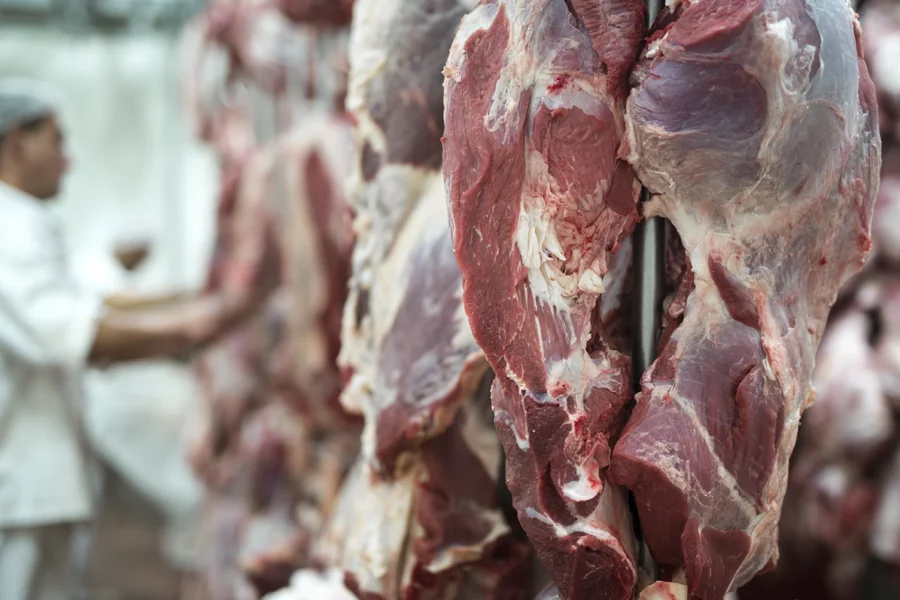
A red meat slaughterhouse is a facility where animals are slaughtered under hygienic conditions and processed into meat suitable for human consumption. In a modern slaughterhouse, the slaughtering process is carried out on carcasses progressing along an overhead rail system.
The slaughter process typically consists of the following stages:
Bleeding: Cutting the neck vessels to drain the animal’s blood
Skinning: Separating the hide from the animal (mechanical or manual)
Evisceration: Opening the abdominal and thoracic cavities, removing internal organs
Veterinary inspection: Inspection of internal organs and carcass by a veterinarian
Carcass splitting: Dividing the carcass into two equal halves
Washing and cleaning: Washing the carcass with clean water
Chilling: Rapid cooling of the carcass
In carcass cutting line design, uninterrupted and hygienic workflow is essential. The slaughter line typically progresses on an overhead rail system mounted to the ceiling. This system enables carcass transportation without manual contact.
After slaughter, carcasses are transferred to carcass maturation rooms. The maturation process is important for meat tenderization and flavor development. Temperature, humidity, and air circulation are precisely controlled in these rooms.
Meat Processing and Packaging Technologies
The meat processing and packaging section is where products are prepared for consumers after the slaughterhouse. In this section, carcasses are cut, deboned, portioned to desired sizes, and packaged.
Cutting and deboning operations are performed with specialized knives and equipment. In modern facilities, these operations are carried out under hygienic conditions at low temperatures (between +8°C and +12°C).
Regarding packaging technologies, the most common methods for meat products include:
Vacuum packaging: Vacuum-sealing the product with an airtight film
Modified atmosphere packaging (MAP): Replacing the air inside the package with a specific gas mixture (typically oxygen, carbon dioxide, nitrogen)
Shrink packaging: Covering the product with heat-shrinkable film
These packaging methods extend product shelf life, prevent color and flavor loss, and slow microbial growth.
Sausage and Salami Production Line and Advanced Processing
The sausage and salami production line is a facility where meat products are transformed into value-added products through advanced processing. Various meat products (sausages, salami, sucuk, pastırma, kavurma, ham, etc.) are produced in these facilities.
The sausage and salami production process typically consists of the following stages:
Meat preparation: Preparation and grinding of lean meat and fat tissue
Curing: Addition and mixing of additives such as salt, nitrite/nitrate, sugar, spices
Emulsification: Homogenization of meat, fat, water, and additives into a mixture (cutter)
Filling: Filling the prepared mixture into artificial or natural casings
Cooking/smoking: Cooking, smoking, or drying the products
Cooling: Rapid cooling of products
Packaging: Slicing and packaging products
Advanced processing refers to processes that add further value to meat products. Processes such as marination, breading, pre-cooking, and sous-vide are considered within advanced processing. Such products are particularly important for the catering, fast-food, and ready-meal sectors.
Waste Management and Environmental Protection
Integrated meat facilities have high potential for organic waste and wastewater. Wastewater generated in slaughterhouses and processing facilities contains high amounts of blood, fat, protein, and organic matter. Direct discharge of this water into receiving environments can cause serious environmental problems.
Wastewater treatment systems in integrated meat facilities typically consist of the following stages:
Pre-treatment: Physical treatment units such as screens, sieves, grease traps
Equalization: Balancing wastewater flow and concentration
Chemical treatment: pH adjustment, coagulation, flocculation
Biological treatment: Removal of organic matter through activated sludge or biofilm systems
Sedimentation: Settling of sludge after biological treatment
Disinfection: Disinfection of treated water (when necessary)
Additionally, slaughterhouse by-products (hides, bones, fats, blood, etc.) can be appropriately processed and transformed into value-added products. For example:
Hides: Raw material for tanning industry
Bones: Gelatin, bone meal, animal feed
Fats: Soap, biodiesel, animal feed
Blood: Blood meal, animal feed, food additives
Investment Incentives and Grants
Red meat processing facilities are among the most supported sectors under TKDK IPARD and KKYDP programs. Grant support is provided for the establishment and modernization of red meat and red meat products processing facilities under the Processing and Marketing of Agricultural and Fishery Products measure.
Supported investment items include:
New facility construction or modernization/expansion of existing facilities
Slaughterhouse equipment, carcass handling systems
Cutting, deboning, mincing units
Advanced processing (sausage, salami, sucuk, etc.) lines
Cooling and freezing systems
Packaging machines (vacuum, MAP)
Wastewater treatment systems
Quality control laboratory equipment
Additionally, extra grant support is provided for renewable energy usage, wastewater treatment systems, recycling, and circular economy investments. Following project approval, 50% of the grant amount is paid in advance against a letter of guarantee.
Our company stands by you with its expert team in all stages of your integrated meat facility investments, from feasibility studies to project design, grant application processes to commissioning. We help you establish competitive enterprises in the red meat sector by building hygienic, efficient, and sustainable facilities compliant with international standards.