
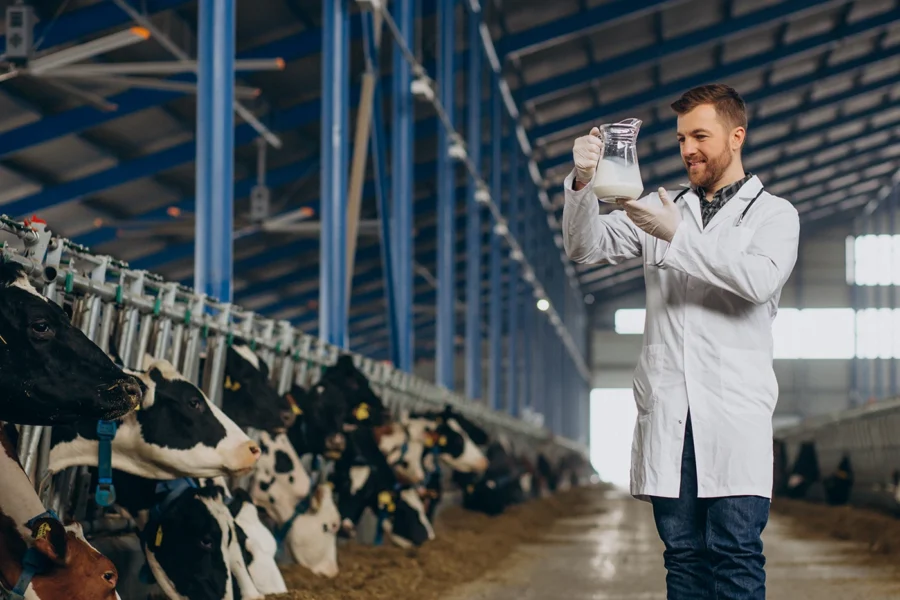
Livestock and Milk Production Facilities: Modern Barn Systems, Milking Technologies, and Sustainable Animal Husbandry
Cattle farming forms the foundation of red meat and milk production in Turkey. However, traditional animal husbandry methods face many challenges such as low productivity, high labor requirements, and animal health issues. Modern livestock and milk production facilities offer solutions to these problems, increasing the efficiency and profitability of animal husbandry operations.
Modern Livestock Farms and Barn Systems
A livestock farm project aims to maximize meat yield by optimizing animal housing, feeding, and health conditions. In a modern livestock farm, barn design is critical for animal welfare and operational efficiency.
The basic elements to consider in cattle barn design are:
Ventilation: Clean air circulation must be ensured inside the barn, and harmful gases (ammonia, carbon dioxide) must be removed.
Lighting: Natural and artificial lighting should be sufficient to regulate animals’ biological rhythms and increase productivity.
Feeding areas: Feeders designed to allow animals to consume feed comfortably while preventing feed contamination.
Resting areas: Compartments covered with appropriate floor material where animals can lie down and rest comfortably.
Transition areas: Corridors where animals can move comfortably for procedures such as milking, weighing, or treatment.
In modern livestock farms, automatic feeding systems are widely used. These systems automatically distribute feed prepared according to ration formulation to animals at specified times. Thus, labor requirements decrease, feed consumption is controlled, and regular feeding of animals is ensured.
Milk Production Facilities and Milking Technologies
Milk production facilities are complex structures housing milking units, milk cooling tanks, feed preparation units, and manure management systems. In these facilities, a delicate balance must be established between productivity, milk quality, and animal health.
The milking unit is the heart of the milk production facility. Milking units can be of different types according to the size of the operation and preferences:
Stationary milking systems: Systems where animals come to a specific area to be milked (parallel, tandem, herringbone, carousel, etc.)
Mobile milking systems: Systems where milking is performed by going to the area where animals are located
Automatic milking systems (Robotic milking): Advanced technology systems where animals voluntarily enter and are milked by a robot
Automatic milking systems are the most advanced solution in terms of animal welfare and labor efficiency. In these systems, animals voluntarily enter the milking unit, the robotic arm cleans the teats, performs the milking process, and analyzes the milk. The system records each animal’s milk yield, milking time, and milk quality, providing detailed reports to the farm owner.
To preserve the quality of milked milk, the use of a cooling tank is mandatory. Milk must be rapidly cooled after milking to +4°C and maintained at this temperature. Modern cooling tanks are equipped with features such as automatic washing systems, temperature recording devices, and agitators.
Milk Processing Facilities (Dairies)
A milk processing facility (dairy) is a facility where raw milk is processed into products such as drinking milk, yogurt, cheese, buttermilk, and butter. In dairy projects, hygiene conditions and product quality must be prioritized.
Milk processing facilities typically include the following units:
Milk reception unit: Section where raw milk is received, filtered, and cooled
Pasteurization unit: Heat treatment unit where milk is freed from harmful microorganisms while preserving its nutritional value
Yogurt production line: Section where yogurt is produced through fermentation of pasteurized milk
Cheese production line: Section where coagulation, cutting, mixing, molding, and brining processes are performed
Packaging unit: Section where products are packaged under hygienic conditions
Cold storage: Cold room where products are stored until shipment
Manure Management and Environmental Protection
In cattle farming operations, manure management is of great importance both for environmental protection and farm economics. Manure management systems encompass the processes of collecting, storing, processing, and disposing of manure generated in barns.
Various methods are used for manure management in modern facilities:
Scraper systems: Automatic or mechanical systems that ensure regular collection of manure within the barn
Slatted floor systems: Systems where manure falls through slatted floors where animals stand to a storage area below
Manure separation systems: Systems where solid and liquid manure are separated from each other
Biogas plants: Systems that enable energy production from manure
Biogas plants are advanced technology solutions providing both environmental and economic benefits in manure management. In these plants, manure is subjected to fermentation to produce biogas (methane). The obtained biogas can be converted into electrical and thermal energy to meet the farm’s energy needs or sold to the grid. The fermented manure resulting from fermentation can be used on agricultural land as a more homogeneous organic fertilizer that is more easily absorbed by plants.
Investment Incentives and Grants
Livestock and milk production facilities are among the priority sectors supported under TKDK IPARD and KKYDP programs. Particularly:
Milk and dairy products processing facilities
Red meat and red meat products processing facilities
Diversification of farm activities and business development projects
can benefit from the IPARD program.
Additionally, extra grant support is provided for renewable energy use (including biogas plants), wastewater treatment systems, recycling, and circular economy investments.
Our company stands by you with its expert team in all stages of your livestock and milk production facility investments, from feasibility studies to project design, grant application processes to commissioning. With our projects prioritizing animal welfare, productivity, and sustainability, we help you establish profitable and competitive animal husbandry operations.